
 Black powder in Battery recycling: Composition, Process and Value-Industry News-Jiangxi Mingxin Metallurgy Equipment Co., Ltd.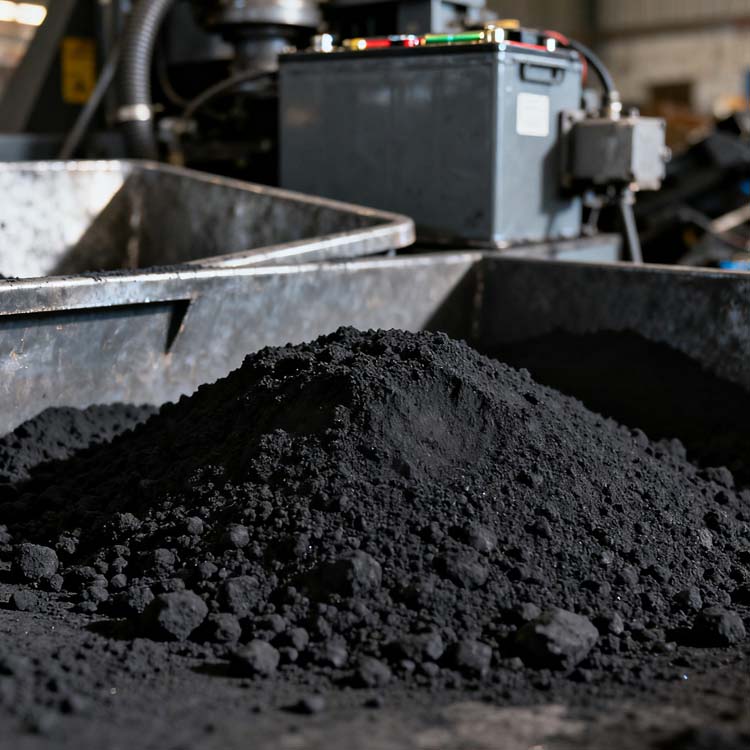
In the industrial chain of used lithium battery recycling, "black powder" is a highly valuable core intermediate product. Its composition and recycling process directly determine the efficiency and economy of battery resource recycling and utilization, and at the same time play a crucial role in reducing environmental pollution.
I. Definition and Sources of Haters
The "black powder" in battery recycling, officially known as "powder of active material from the cathode of used lithium batteries", mainly comes from the disassembly and sorting process of used lithium-ion batteries (such as ternary lithium batteries and lithium iron phosphate batteries). When used batteries are discharged, their casings are disassembled, the electrolyte is removed, and the negative copper foil and positive aluminum foil are separated, the black powder-like substance that peels off from the surface of the positive aluminum foil through physical peeling or high-temperature peeling processes is what is commonly referred to as "black powder" in the recycling field. Its output accounts for approximately 30% to 40% of the total weight of used lithium batteries and it is the main carrier of precious metals and key metal elements in batteries.
Ii. Core Components of Black Powder
The composition of black powder varies significantly depending on the type of primary cell and can mainly be divided into two categories:
Ternary lithium battery black powder: The core components are nickel (Ni, usually 15%-30%), cobalt (Co, 5%-12%), manganese (Mn, 5%-15%), lithium (Li, 2%-5%), and it also contains a small amount of aluminum (from the residue of the positive electrode current collector), carbon (conductive agent), and impurity elements.
Lithium iron phosphate battery black powder: Its main components are iron (Fe, 20%-30%), phosphorus (P, 10%-15%), and lithium (Li, 2%-4%), without precious metals such as cobalt and nickel. The impurities are mainly aluminum and carbon.
The composition differences between the two types of black powder directly determine their recycling technology routes and economic values - ternary black powder, due to its content of cobalt and nickel, has a greater profit margin for recycling and is currently the focus of the industry. The black powder of lithium iron phosphate batteries needs to reduce the recycling cost through large-scale production, focusing on the recycling of lithium and iron.
Iii. Mainstream Recycling Processes for Black Powder
At present, the industry's recovery of black powder mainly falls into three technical routes: "pyrometallurgy", "hydrometallurgy", and "dry recovery", each with its own advantages and disadvantages
Pyrometallurgy (high-temperature smelting method)
Principle: Mix black powder with auxiliary materials such as coke and limestone, and melt them at a high temperature of 1200-1500℃. Through oxidation-reduction reactions, metal elements form alloys (such as nickel-cobalt alloys), while lithium is extracted separately after entering the slag.
Advantages: Mature technology, large processing capacity, strong adaptability to raw materials, capable of handling black powder with complex components.
Disadvantages: High energy consumption (about 3,000-5,000 KWH per ton of black powder), low metal recovery rate (about 85%-90% for cobalt and nickel, and only 50%-60% for lithium), and it will cause flue gas pollution.
Hydrometallurgy (chemical dissolution method
Principle: Black powder is dissolved in acid solutions such as sulfuric acid and hydrochloric acid. Through steps like adjusting the pH value and adding an extractant, metal ions such as lithium, cobalt, nickel, and manganese are successively separated out. Eventually, battery-grade raw materials such as lithium carbonate, cobalt sulfate, and nickel sulfate are prepared.
Advantages: High metal recovery rate (the recovery rates of cobalt, nickel and lithium can reach over 95%), high product purity (meeting the requirements of cathode materials for power batteries), and low energy consumption.
Disadvantages: The process flow is long (requiring 10 to 15 procedures), acidic wastewater and waste residue are generated, strict environmental protection treatment facilities are needed, and the initial equipment investment is relatively large.
Dry recovery (physical separation method)
Principle: Carbon and binder in black powder are removed through low-temperature calcination, and then different metal oxides (such as lithium compounds, nickel, cobalt and manganese oxides) are separated by physical means such as high-voltage electrostatic separation and magnetic separation.
Advantages: No wastewater or waste gas is produced, the process is short (3-5 procedures), and the energy consumption is only 1/3 of that of the pyrometallurgical method, making it an environmentally friendly process.
Shortcomings: The technology is not yet fully mature, and it has high requirements for the pretreatment of black powder (impurities need to be strictly removed). Currently, it is only applicable to some high-purity black powders, and breakthroughs are still needed for large-scale application.
Iv. The Significance and Current Industry Situation of Black Powder Recycling
Resource recycling value The global reserves of cobalt and nickel are limited (cobalt reserves are only about 7 million tons), and China's dependence on foreign imports exceeds 90%. The recycling of black powder can achieve the utilization of "urban mines" resources - for every 10,000 tons of black powder from ternary lithium batteries recovered, about 1,000 tons of nickel, 500 tons of cobalt and 300 tons of lithium can be extracted. It is equivalent to reducing the mining of 100,000 tons of raw ore.
Environmental protection and emission reduction significance: If black powder is discarded at will, heavy metals such as cobalt and nickel in it may seep into the soil and groundwater, causing long-term pollution. Through recycling and treatment, the harmless rate of heavy metals can be increased to over 99%, while reducing the emissions of pollutants such as dioxins caused by battery incineration.
Current industry development status: At present, the wet process is the main method for black powder recovery in China (accounting for about 70%). Leading enterprises such as GEM and Huayou Cobalt have already achieved wet recovery production lines with a capacity of over 10,000 tons. The pyrometallurgical process is mostly used to treat low-grade black powder or overseas black powder with high cobalt content. The dry process is still in the pilot production stage. Some enterprises have already built demonstration lines with a capacity of over 1,000 tons. It is expected that it will gradually scale up in the next 3 to 5 years.
V. Future Development Directions
With the arrival of the battery retirement wave (China's retired battery volume will exceed 1 million tons by 2025), black powder recycling will develop in the direction of "low energy consumption, high purity, and full component recovery" : on the one hand, the wet process will reduce costs through new extractants and automated control; On the other hand, the dry process will break through the impurity separation technology and achieve "waste-free" recycling. Meanwhile, for the black powder of lithium iron phosphate batteries, a lithium-iron-phosphate collaborative recovery technology will be developed to enhance its economic value and promote the resource utilization of all types of battery black powder.